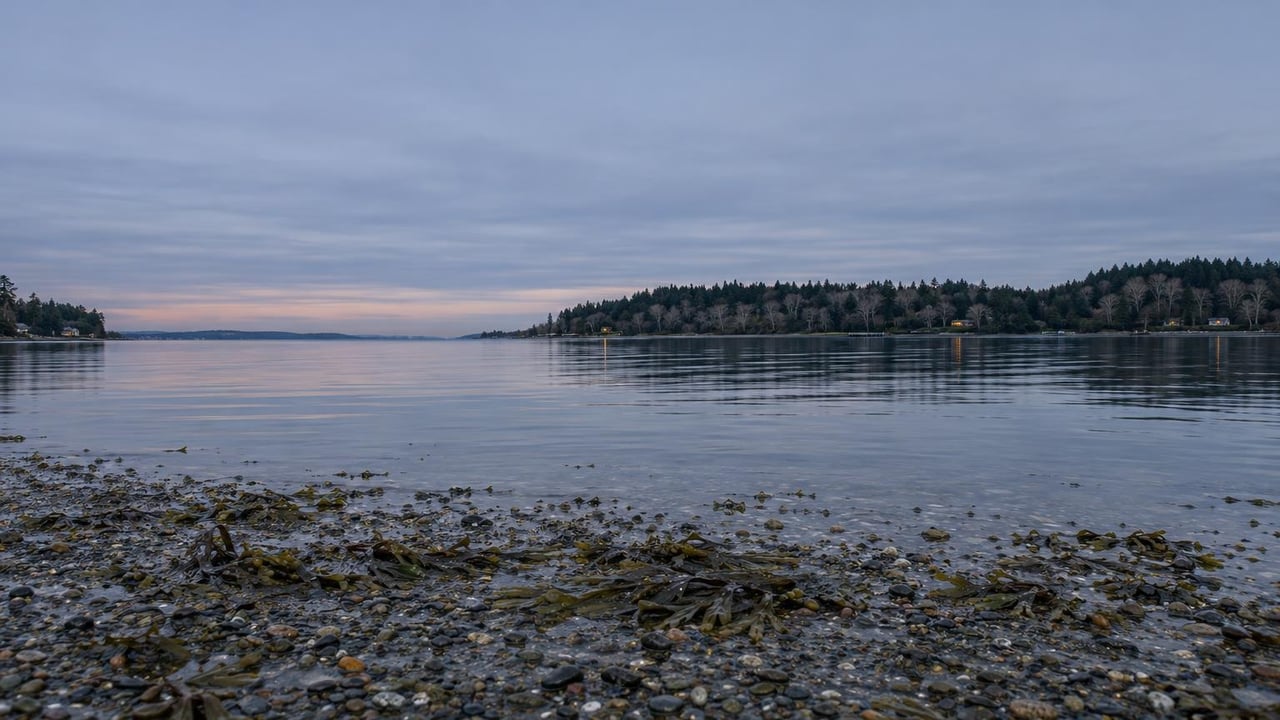
The lowest tide predicted for Eagle Harbor between November and the end of February arrives at 11:03 p.m. on Christmas Eve. NOAA's tide predictions for the Eagle Harbor station put the water that night at 4.007 feet below mean lower low water, the deepest low in the station's forecast from November 1, 2026 through March 1, 2027. That is about as low as the minus 4-foot tide the Bainbridge Island Land Trust picked for its guided Low Tide Walk at Agate Passage Preserve on June 25, 2025. That walk was held by day. This winter the same depth comes near midnight, and nearly every deep low between now and February falls after the island's shoreline parks have closed for the day.
Why the Clock Flips After Summer
Puget Sound has two low tides a day, and they are rarely the same height. A University of Washington tides explainer says the lower of the two generally falls in daytime in summer and at night in winter. It traces the switch to the tilt of the Earth's axis, which gives the sun's pull on the water a once-a-day rhythm that moves around the clock with the seasons. The very deepest lows also cluster for a few days at a time. NOAA's tide tutorial explains that when the sun and moon line up at the new and full moon, they produce spring tides, with especially low low waters.
Together those two effects decide the calendar. The seasonal shift puts the low water in the evening, and the moon's phase decides which handful of evenings go deepest.
The Nights on the Calendar
Eagle Harbor has its own NOAA station, number 9445882. It is a subordinate station keyed to Seattle, with low tides running five minutes off the Seattle times and low-water heights multiplied by 1.02. These are the deepest night lows in its predictions for the rest of this winter, all measured against mean lower low water:
| Date | Predicted low | Height |
|---|---|---|
| Tuesday, December 22 | 9:28 p.m. | -3.362 ft |
| Wednesday, December 23 | 10:15 p.m. | -3.922 ft |
| Thursday, December 24 | 11:03 p.m. | -4.007 ft |
| Friday, December 25 | 11:51 p.m. | -3.596 ft |
| Wednesday, January 20 | 9:13 p.m. | -3.003 ft |
| Thursday, January 21 | 10:03 p.m. | -3.318 ft |
| Friday, January 22 | 10:50 p.m. | -3.163 ft |
| Saturday, January 23 | 11:36 p.m. | -2.494 ft |
| Wednesday, February 17 | 8:04 p.m. | -1.644 ft |
| Thursday, February 18 | 8:58 p.m. | -1.988 ft |
| Friday, February 19 | 9:48 p.m. | -1.960 ft |
Each cluster arrives about 45 minutes later every night. In late December that pushes the lowest water from 9:28 p.m. to nearly midnight over four nights. The late-November run peaked at 11:16 p.m. on November 25, at -3.921 feet, and passed overnight into this morning. By February the night lows are less than half as deep as the Christmas week ones and come earlier in the evening, between 8 and 10 p.m.
All of these numbers are astronomical predictions. The UW explainer notes that winter winds and low air pressure can push the actual water level above what the tide table says. Check NOAA's Eagle Harbor prediction page on the day and expect a stormy night to leave more water on the beach.
The Parks Close Before the Water Drops
Most of the island's guided low-tide outings are on park beaches. Sustainable Bainbridge's summer 2026 explorations, run with WSU Extension and IslandWood, went to Point White Pier on June 13 and the ferry terminal beach on July 12, and WSU Extension led one at Rockaway Beach on August 10. Every one of those was a daytime tide.
The Bainbridge Island Metro Park & Recreation District posts dawn-to-dusk hours for those same shorelines. Its page for Pritchard Park describes 50 acres on Eagle Harbor with nearly a mile of shoreline. The western portion is co-owned by Metro Parks and the City, and the eastern half is City-owned. The page lists the park as open dawn to dusk. Point White Pier is a former Mosquito Fleet ferry dock that is now used for fishing and scuba diving, and the District lists the same dawn-to-dusk rule for it. So does Rockaway Beach, a half-acre shoreline park on Blakely Harbor. Fort Ward, with its long, rocky beach on Rich Passage, lists dawn to dusk in one place and 8 a.m. to dusk in another. Both versions close it at dusk.
Every low in the table above falls after dusk, between 8 p.m. and nearly midnight, so the well-known shoreline parks are closed on the nights that bring the season's best tides.
One Guided Night on the Ferry Terminal Beach
The Sustainable Bainbridge Beach Naturalists have scheduled a single winter exploration. It is set for Wednesday, January 20, 2027, from 8 to 9:30 p.m., on the beach by the Bainbridge ferry terminal at 400 Harborview Drive SE, on the Eagle Harbor shoreline. The group's event listing calls it their "one exploration of the winter." The timing lines up with the tide. NOAA predicts that evening's low at 9:13 p.m., at -3.003 feet, so the walk runs right up to the bottom of the low.
The way in starts in downtown Winslow. The naturalists ask people to park in town and take the Waterfront Park trail, cross the ravine bridge, and follow the Waterfront trail across Harborview Drive and behind the condominiums to the beach access. Once there, look for naturalists in neon green vests.
The listing is specific about gear. Bring a strong flashlight, which it says all fall and winter night explorations require. Wear shoes or boots that can get wet, because much of the walk is in shallow water along the shore, and tall rubber boots are the footwear of choice. The beach can be much colder than the rest of the island, so bring layers. A hiking stick helps on the slippery, seaweed-covered rocks. Children are welcome, and dogs should stay home.
What Turns Up Under a Headlamp
The Beach Naturalists do more than lead walks. Sustainable Bainbridge describes the volunteers monitoring beach composition and species, including mussels, sea stars and green crabs. On a night walk, the people holding the flashlights are the same people who track what lives on these beaches through the year.
Night changes some of what you see. The Seattle Aquarium's Puget Sound beach guide notes isopods swimming across tide pools at night. When KUOW followed a night tidepool walk in Edmonds in February 2025, the group found anemones, barnacle-eating nudibranchs, a shaggy mouse nudibranch, sea stars, crabs, baby eels and egg pods. A naturalist on that walk told KUOW that crabs may be more active out in the open at night. On the island itself, Metro Parks says low tide at Rockaway Beach shows abundant marine life, and divers there can see underwater fissures.
The Aquarium guide's wider list of Puget Sound beach finds includes sea stars, anemones, crabs, nudibranchs, moon snails, sea cucumbers and the animals that live in eelgrass. The Land Trust's June 2025 walk at Agate Passage named eelgrass, nudibranchs and moon snails on that stretch of the island's north end.
Moving Carefully in the Dark
A flashlight shows you less than daylight does, and the advice for tidepooling is written for daylight. NOAA's tidepooling guidance says to step on bare rock, leave animals attached where you find them, put any rock you lift back the way it was, and keep watching the incoming tide. It also warns about algae-covered surfaces, asks for sturdy shoes, says to keep children close, and says dogs do not belong on tidal rocks. The Aquarium guide adds a gentler rule for touching. Use one wet finger, take nothing home from the beach, and leave no litter. The Bainbridge naturalists give a local reason to slow down: animals on the ground can be hard to see and are sometimes covered by seaweed.
On January 20, the predicted low is at 9:13 p.m., and the walk ends at 9:30, 17 minutes after the water reaches its lowest point.
Eagle Harbor is part of the life we share with our clients, and we're always glad to talk about the shoreline. If you're thinking about life near the water on Bainbridge Island, The Agency Bainbridge Island would be glad to hear what you're looking for. Schedule a private consultation.